Thursday, 28 November 2013

Best Books to Read before Traveling to Morocco


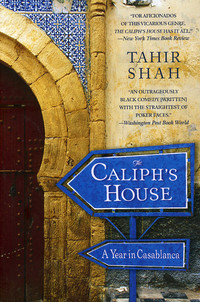
The Caliphs House
Before visiting Morocco there are some must read books that will enhance your travel experience. From guide books to fiction and non fiction taking hold of a vacation whether you are traveling on budget or a luxury private tour is easily done. It is also important to have a good guide book to inform and orient you when taking a Morocco tour. With a wide range of guide books available the ones that come out on top are the Rough Guide to Morocco and Lonely Planet Morocco. Both serve as a reliable and practical introduction to the history of Morocco along with its urban and rural life. Both guide books also offer travelers information about Morocco's souks, historic sites, best places to eat and shopping options.  There are a growing number of guide books to Morocco  and local city guides as well however Rough Guide and Lonely Planet are generally reckoned to be the best and most up to date available on the market.
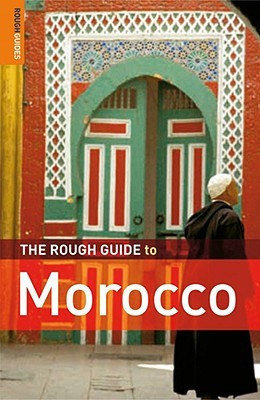
Rough Guide to Morocco
The best cultural and historical introduction  to Morocco with the emphasis on joie de vivre and an appreciation of Morocco’s Malakite spiritual rite of Islam and the way it influences daily life, is Barnaby Rogerson’s Cadagon Guide. It captures the essence of locations both urban and rural and relates their history and cultural value. It is more of an introduction to Morocco than a simple guide but it is the best account of the adventure and excitement to be had from north to south.
There are also a number of authors who have related their impressions of Morocco as it used to be which are useful for understanding Morocco and its history in the 19th and early 20th centuries. Barnaby Rogerson’s publishing house Eland also publishes a number of anthologies of writers on Morocco such as Marrakech the Red City, which contains George Orwell’s impressions of Marrakech, amongst other well known writers.
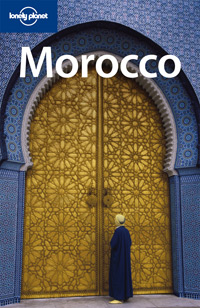
Lonely Planet Morocco
Eland also publishes important authors on Morocco which would otherwise be out of print including The Lords of the Atlas by Gavin Maxwell which is an account of feudal Morocco from before the First World War to Morocco’s independence in 1956 and the rule of Thami El Glaoui and his family during the French Protectorate. Moroccans remain ambivalent about the Glaoui’s role but it is an important part of Morocco’s history as Churchill and Roosevelt and many other personalities came to Morocco before and after the Second World War.
The book which Lords of the Atlas is said to have partly relied on is Morocco That Was by Walter Thomas correspondent for the Times in Tangier relates many amusing stories of intrigue in the court of Sultan Abdelaziz in the 1890’s and early 1900’s.
In Morocco written by the American novelist Edith Wharton published in 1920 tells of her visit to Morocco at the invitation of the Resident General of the French administration in Morocco the famous General Hubert Lyautey in 1917. Edith Wharton had been decorated by France for her work with refugees during World War 1 and her book is said to be the first travel guide of Morocco. There are vivid encounters with the wild Berber tribesmen in the Medina of Marrakech and in the houses of the gentry with their restricted role for women in the household and harems of Rabat and Fez. She is sometimes criticized for being too pro French but in truth the colonial administration did much for Morocco under Lyautey, particularly with regards to preservation of Morocco’s historic buildings, finding and saving the Saadian tombs in Marrakech for instance.
Also published by Eland is A Year in Morocco by Peter Mayne which recounts the author’s experiences as he interacts with the local and foreign inhabitants of Marrakech and is useful for understanding some of the foibles, customs and pitfalls for trying to set up house in Marrakech.
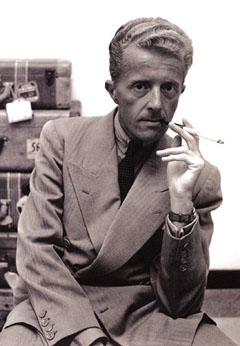
The American novelist Paul Bowles spent 52 years in Tangiers and he writes about the city he loved in his collection of travel writing Travels published by Sort Of Books. His novels and short stories also include Morocco often and he played an important role in recording Berber tribal music which is now preserved in the US Library of Congress. A good description of Tangier from 1962 to 1979, which features Bowles and his friends and the Beat generation is The Tangier Diaries by John Hopkins.
The novelist Tahir Shah wrote The Caliph’s House about moving to Casablanca and the challenges he and his family faced in renovating a derelict palace infested with Jinns (Moroccan evil spirits) with whom he has frequent encounters. In his other novels he blends his Afghan heritage and knowledge of the east of his forefathers and their long experience of Morocco to produce an exciting and dramatic read. His infectious enthusiasm for Morocco and Casablanca is also evidenced by frequent travel articles in the international press.
Laila Lahlimi is a Moroccan novelist who published her novel Sacred Son in English in America, being the first Moroccan to do so. It provides an interesting view of different generational attitudes and clashes in today’s Morocco.
A good introduction to the finer points of the does and don’ts of Moroccan society is Culture Shock by Orin Hargraves. Different attitudes to timing and the primacy of family life and the necessary white lie figure prominently.
Moroccans speak their own dialect, darija in everyday life and the best way to really connect with Moroccans is to learn some greetings and phrases in their dialect. Lonely Planet’s excellent little phrasebook Moroccan Arabic with useful words and phrases is an essential companion on your Moroccan tour.
A List – Best Books to Read Before Traveling to Morocco
HISTORY 
  • Morocco That Was – By  Water Harris
  • Morocco Since 1830  –  By C.R. Pennell
  • Lords of the Atlas: The Rise and Fall of the House of Glaoua  –  By Gavin Maxwell
  • The Conquest of Morocco – By Douglass Porch
FICTION & NON- FICTION  
  • Culture & Customs in Morocco – By Raphael Njoku
  • In Arabian Nights: A Caravan of Moroccan Dreams – By Tahir Shah
  • The Caliph’s House: A Year in Casablanca – By Tahir Shah
  • The Spiders House – By Paul Bowles
  • The Sheltering Sky – By Paul Bowles (Book & Film)
  • Let It Come Down – By Paul Bowles
  • The Last Storytellers: Tales from the Heart of Morocco –  By Richard Hamilton
  • Their Heads are Green & Their Hands are Blue – By Paul Bowles
  • Dreams of Trespass: Tales of A Harem –  By Fatima Mernissi
  • Berber Odes: Poetry from the Mountains of Morocco – By Michael Peyron
  • The Hamadsha: A Studio of Moroccan Ethnopsychiatry
  • A House in Fes –  By Susannah Clarke

the november afternoon in Marrakesh

... perhaps it was the 5% Casablanca beer quickly supped over lunch at Cafe Arabe, but mid-afternoon, en-route to Marrakesh's pre-industrial leather tanneries, I found myself cast adrift in the maze of the medina. That familiar point of reference, the minaret of the Koutoubia Mosque, could no longer be seen, blocked as it was by a makeshift hessian roof keeping the warren of sun-baked lanes shaded. Many doors were bolted as the shopkeepers dozed at the mid-point of the month-long Ramadan fast.
Carts trundled past, laden with oranges and timber, while hawkers who had not closed shop called out "good price, just looking?". I spied a blue sign for the main square, Djemaa el-Fna, but that was no use. I concluded that I had a cocktail in Kabul's chance of finding my way, and that my map was useless.
I stood scratching my head, when suddenly a tug on my sleeve: "Madam, you are looking for spices?"
"No" I huffed tiredly, shuffling down another lane, no wider than a donkey. "You look my brother's shop?" he asked me. In need of mint tea and a sit down, I agreed. The boy, Mohammed, smiled and skipped alongside me. Soon tourists and kitschy souvenirs disappeared and, instead, food was everywhere. Piles of eggs, fruits of all colours, fresh herbs. Brightening, I took my camera and snapped a man working an ancient weaver's loom. Then I stopped by a carpenter's shop to ask the price of sandalwood kebab pole. "Sixteen dirhams," I was told, less than a couple of euros, and was sold a decent souvenir entirely by accident. Further along, I bargained for some ridiculously cheap pistachios.
We walked on. "Do you know why a hammam is always next to a bakery?" Mohammed asked. I shook my head. "Because the heat from the bathers helps the bread to rise, look, here." Ducking through a tiny door, we were greeted by puffs of freshly baked khoubz. The men happily posed for photos and I paid for a couple of still-warm discs of dough.
After, Mohammed quickened, motioning that we were close. He opened an unmarked door in Souk Souafine and ushered me in. A brightly coloured apothecary opened up, where hundreds of jars containing everything from voodoo-esque pickled birds and crystals to more typical saffron lined the shelves. I parted with a few more dirhams for some ras el hanout spice blend and, sipping a steaming tea, concluded that in less than an hour I had compiled a Moroccan hamper to make most foodies back home green with envy... /cEden


who we are?

Atlas Desert Tours Company is based in Rissani, the south east of Morocco. We offer customized tours and itineraries that will ensure you have an overwhelming and unforgettable journey around Morocco.Our clients are guaranteed high standards of quality service through our competent, well-trained and experienced drivers and knowledgeable guides, who give special personalized care and attention to our customers as they share their knowledge, passion and pride for this beautiful country. Our experience and knowledge in the travel industry for many years contribute to make Atlas Desert Tours a great company to tour Morocco with. We are local guides who speak fluent English, Spanish, French, Arabic and Berber. We invite you to learn more about Morocco’s places, people, food, history and culture and to allow us to properly present why we are the top choice in the market.


Our mission in Atlas Desert Tours is offering exciting tour programs that are tailor-made for individuals, couples and groups, who want to visit various places within Morocco in order to experience and savour Morocco’s beauty.
Atlas Desert Tours is among the best tour and travel companies in Morocco. You can be confident that you will receive great services at reasonable prices. We pay great attention to details, including safe and driving skills; and help you get the most out of your stay in Morocco.
We specialize in tailor-made travel and tours, Sahara Desert excursions, camel trekking, car hire, transfers, accommodations and much more... Our range of comfortable transport facilities include: 4 x 4 vehicle or mini-van and small cars.
We are here to assist you bring your travel dreams to reality. This is what makes us stand out from the crowd and like you will experience, we are different. Just send us your inquiry directly by e-mail or give us a call and we will do the rest.


Adresse Marakech El Mhamid 40 000
E-mail: info@atlasdesertours.com
Phone: +212 613 385 341
Patente : 46037060
RC : 48376935


www.atlasdesertours.com


Wednesday, 27 November 2013

Majorelle Garden - Marrakesh

The Majorelle Garden (Arabic: حديقة ماجوريل) is a botanical garden and artist's landscape garden in Marrakech, Morocco. It was designed by the expatriate French artist Jacques Majorelle in 1924, during the colonial period when Morocco was a protectorate of France.
Majorelle was the son of the Art Nouveau ébéniste of Nancy, Louis Majorelle. Though Majorelle's gentlemanly orientalist watercolors are largely forgotten today (many are preserved in the villa's collection) the gardens he created is his creative masterpiece. The special shade of bold cobalt blue which he used extensively in the garden and its buildings is named after him, bleu Majorelle—Majorelle Blue.
The garden hosts more than 15 bird species, which can be found only in the area of North Africa. It has many fountains, and a notable collection of cacti.

Jacques Majorelle is born in 1886 in Nancy (France). In 1919 he settles in Marrakech to continue his career of painter, where he acquires a ground which was going to become the Majorelle garden. Since 1947 he opens his garden's doors to the public. Following a car accident, he returns to france, where he dies in 1962. in 1980 Pierre Bergé and Yves Saint Laurent repurchase the garden and restore it.

Contrasts, the colors, the light games seem go out of one of the pictures of Jacques Majorelle. It was one of the more important collectors of plants of his era, and this is in this spirit than enlarges itself from day to day the flore of the garden. Plants of the five continents are exposed in an enchanting framework. This that was the workshop of Jacques Majorelle, inspiration place and of contemplation, shelters today the magnificent art collection Islamic of Pierre Bergé and Yves Saint Laurent. The originality of these places lies in the combination of a luxurious végétation and architectural elements allying sobriété and traditional aesthetic Moroccan. The power of the blue Majorelle participates in the freshness impression and of quiétude.

www.jardinmajorelle.com

Morocco’s International Marathon – A Running Tour Through Marrakech

The International Marathon at Marrakech is considered one of the most prestigious marathons in the world and boasts a beautiful and exotic setting for its runners. The route itself, which was designed by an international judge after visiting the most beautiful sites in Marrakech, winds itself down palm tree-lined streets, through orange and olive groves, past historical monuments and along the walls of the city itself.
As well as being a hot spot for marathon runners, Marrakech is also a prime destination for tourists who wish to discover and experience the “real” Morocco. The small and narrow streets of Marrakech never allowed for the car to be completely integrated into every day life giving the city a more rustic and authentic feel.
A must-see in Marrakech are The Great Souks – or marketplaces – that can be found in the north of the city. Locals and visitors alike marvel at the labyrinth-like construction of these roofed-in markets that offers everything from food and carpeting to water jugs and spices of every color.
At the center of the city is Jemaa el-fna, an open square that is thought to be at least a thousand years old. During the day visitors can expect to find street performers dressed in colorful costumes, snake charmers, and orange juice stands but it is at night when the real fun starts. As the sun sinks below the horizon and the snake charmers depart the square begins to fill up with Chleuh dancing boys, story tellers, magicians, and peddlers of traditional medicine. Dozens of food stalls crowd the square as tourists and locals enjoy the nightly entertainment.
The Mosque of Koutoubia, thought to be the landmark of Marrakech, was first built in 1147 and boasts the oldest of three remaining great Almohad minarets in the world. The original Mosque of Koutoubia had to be knocked down because it did not align correctly with Mecca but was rebuilt by 1199.
The Majorelle Garden is a botanical garden that was created in the 1920’s by the French artist and expatriate Jacques Majorelle. Majorelle created a small paradise filled with exotic flowers and plants from around the world and a private residence modeled after Marrakech palaces. The lush gardens, pools, exotic birds, and the dazzling blue structures make the Majorelle Garden another must-see for any visitor of Marrakech.
So whether you’re a marathoner who wants to feel what it’s like to run down palm tree-line streets and through orange orchards and olive groves or just an eager traveler looking for the next great adventure Marrakech may be the city for you.


Films to watch before travelling to Morocco

Two older well known films featuring Morocco are Hitchcock’s The Man Who Knew Too Much which features James Stewart and Doris Day and was made in 1956. It has all the tense drama of a Hitchcock thriller and has a scene on the Jemma el Fna square where Hitchcock makes a cameo appearance looking at acrobats on the Place in a cafe as a man is stabbed nearby. The French built fortress like police station on the square features prominently in the film. It was made in the same year as Morocco gained independence and captures some of the excitement of the period.
The film Casablanca in 1942 starred Humphrey Bogart, Ingrid Bergman, and Paul Henreid and features Claude Rains as the French police officer, Conrad Veidt, Sydney Greenstreet, Peter Lorre, and Dooley Wilson. All the scenes were shot in a Hollywood studio but the Moroccan street scenes are not too bad and the romantic drama won 3 Academy awards. The hero Humphrey Bogart has to choose between the woman he loves played by Ingrid Bergman and helping her husband in the Czech resistance escape the pro Hitler Vichy forces in Morocco. The picture accurately portrays the war time drama and the plight of refugees in Morocco during the Second World War and was rushed out to coincide with the Allied landings during operation Torch in North Africa in 1942. It is one of the great romantic films with some of the greatest cinema actors of all time. Casablanca still basks in the glory and today’s Rick’s Bar is well worth a visit, you can watch the film as well.

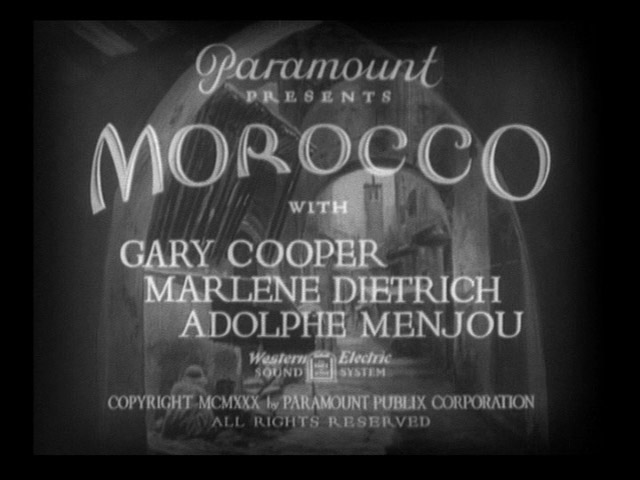
Morocco, Gary Cooper, Marlene Dietrich & Adolphe-Menjou
Josef Von Sternberg’s production of Morocco in 1930 with Marlene Dietrich and a very young Gary Cooper who is serving in the French Foreign Legion. The film opens with a legionnaire column marching into Mogador . The column stops in the souk and waits as the call to prayer rings out and the people pray, the scenes are very well observed. The shots of life as a legionnaire give an idea of what the period under the French Protectorate was like. This is the film where the young Marelene Dietrich caused a sensation by singing in the local nightclub in top hat and tails and kissing a woman who gave her a white rose after her performance. Both the heroine and hero have a troubled past and a are trying to found a new life in Morocco. It again explores the theme of Morocco as a land of eastern mystery where the characters can find themselves. In the end she follows the legionnaire column into the desert to be with her true love despite the wealth and security offered by another suitor.
The film Hideous Kinky came out in 1998 starring Kate Winslet and Said Taghamoui. In 1972 Jane’s two daughters Bea and Lucy move to Marrakech to escape the boring routines of London. The film captures the hippy period in Morocco. Both Kate Winslet ‘s character and her two daughter’s also go through a voyage of discovery aided by Said Taghamouti’s character who helps them to return to London.

Paul Bowles
The American novelist Paul Bowles narrates Bernado Bertolucci’s version of his great novel The Sheltering Sky starring Debra Winger and John Malkovich and Campbell Scott. As often happens the novelist did not like the film, the novel was perhaps too stark for a Hollywood extravaganza. There are great desert scenes and Paul Bowles appears in a cameo part as well as narrating the film. He spent 52 years living in Tangier writing and thinking about Morocco during his own personal journey of discovery. He was the best known American expatriate in Morocco of the period and introduced many writers of the period to the country.
If you search on Youtube you will find films of old Morocco in 1920,1930,and 1950’s and vivid street scenes and it is thrilling to see places as they were then and are now in modern Morocco. You can also find historic pictures of Mohammed V, Churchill and De Gaulle reviewing French troops in Marrakech during World War II as well as the historic Casablanca conference with President Roosevelt.
Morocco is a very photogenic country because of its string scenery and great films such as David Lean’s Lawrence of Arabia, Orson Welles’s Othello shot in Essaouira, Martin Scorsese’s, Kundun and also the Temptation of Christ. Many international films continue to be made in Morocco and Morocco has its own burgeoning film industry and film stars.

www.atlasdesertours.com